

Hunting Springbuck in South Africa
Few African antelope are as instantly recognizable as the springbuck. Its rich tan coat, bold flank stripe, and white belly are striking against the veld, while a mature ram’s ridged, inward-hooking horns make a handsome trophy. South Africa’s national animal belongs on a classic African hunting list. For many visiting hunters, hunting springbuck in South Africa is something of a rite of passage, a chance to hunt an animal they have associated with Africa for years.
At Rocklands Safaris, near Fort Beaufort in South Africa’s Eastern Cape, we build your safari around the species you want to hunt, and the way you prefer to hunt. Whether springbuck is your first African trophy or an animal missing from your collection, understanding the species will help you arrive prepared.
Key takeaways
- Springbuck and springbok are the same species.
- Short grass and open, dry ground suit them best.
- Both sexes have horns, so correct identification matters.
- Trophy quality includes maturity, horn length, and mass.
- May through August is a strong starting window.
Ready to enquire? Let’s plan your hunting safari today!
What is a springbuck
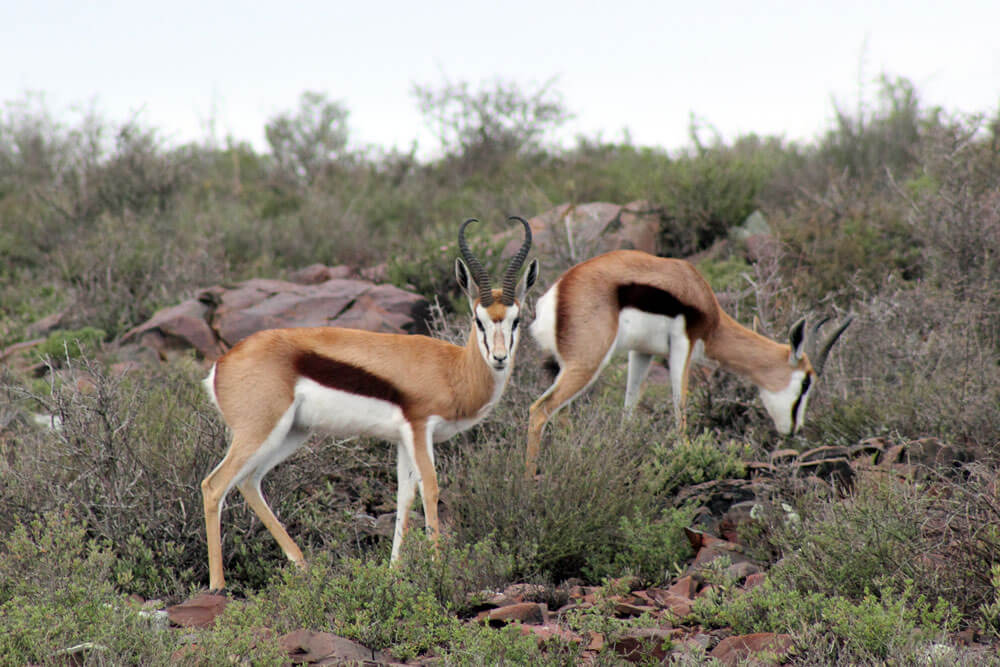
A springbuck, also spelled springbok, is the antelope Antidorcas marsupialis. The common form has a tan back, white belly, dark stripe along each flank, and dark facial markings. Mature animals stand roughly 28–35 inches at the shoulder. Weight varies with sex and population, broadly around 55–100 pounds, with rams generally heavier than ewes.
Both sexes carry black, ridged horns. A ram generally has heavier bases and more substantial horns, but a distant view of horn length alone is not enough to identify him correctly.
Springbuck habitat in South Africa
Springbuck favor dry plains, short grass, and low shrubs. The Karoo, Northern Cape, Kalahari, and open Free State grasslands are characteristic habitat. Reintroductions and game ranching have also established populations elsewhere.
They eat grasses and browse, changing their diet with available food. Moisture in vegetation can reduce their need to drink regularly. Dense woodland, tall grass, and persistently wet ground are less suitable than relatively dry, open veld.
Rocklands has varied terrain that includes bush and the open sections ideal for a springbuck. Your PH is an expert hunter and tracker. We will discuss the hunting area and confirmed availability when planning your safari. Our guide to hunting gemsbok in South Africa introduces another dry-country antelope you may want on your list.
Springbuck behavior
Springbuck can be found in herds, bachelor groups, and as territorial rams. With several animals together, a feeding ram can appear unaware while another animal is watching your approach. So, its best to account for the whole group.
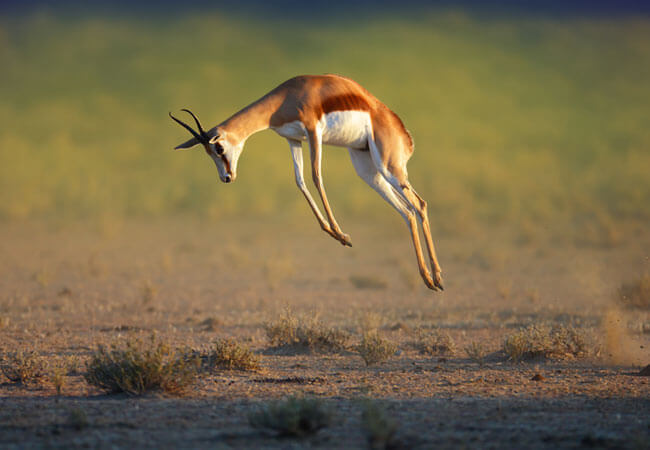
Their stiff-legged leaps are called pronking. During the display, a fold of skin along the back opens to expose white hair. Pronking can be due to excitement or disturbance; it doesn’t mean that a hunter has been seen.
What makes a good springbuck trophy
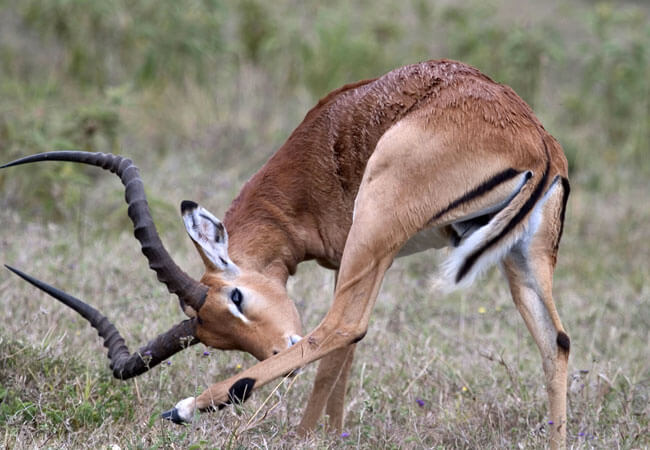
A good trophy ram combines maturity with well-developed horns. We look at the animal’s body and behavior alongside horn thickness, length, shape, and condition. Strong bases and substantial horns help distinguish a ram from a finer-horned ewe; no single feature should carry the decision.
Common springbuck horns around 12–14 inches can make a good representative trophy, while horns beyond 15 inches are exceptional. These are broad field benchmarks. Population differences, individual variation, and viewing angle affect expectations, and a field estimate cannot promise a measured score.
The horns sweep outward before the tips hook inward. Heavy ridging and intact hooks give a mature ram much of his character. Broken tips or uneven horns affect measurements, although an older animal with worn horns can still be a meaningful trophy.
Horn length is measured along the curve. SCI scoring includes both horn lengths and base circumferences; Rowland Ward uses the longer horn for its horn-length criterion. If record-book entry matters to you, explain that before booking.
Springbuck have permanent horns, unlike deer that shed and regrow antlers. There is no annual antler cycle to time your safari around. Nor does the longest-looking horn automatically identify the oldest animal.
Common black, white, and copper springbuck
Common black, white, and copper springbuck are color forms of the same species. Hunting all four is often called a springbuck slam. The common animal’s contrasting flank stripe and white underside make it a distinctive trophy in its own right.
The best season to hunt springbuck
May through August is a useful starting window for planning a South African springbuck safari. Cooler conditions favor time on foot, and the southern winter is a widely preferred period for visiting trophy hunters.
For hunters from the United States and Europe, this falls during your summer. African winter mornings can be cold even when afternoons are comfortable. Pack layers, including a warm outer layer for early vehicle journeys.
Rainfall patterns differ across South Africa, so winter does not mean dry weather everywhere. Recent rain, vegetation, and the species taking priority all influence the choice of dates. We will confirm dates that suit the proposed area and its hunting authorizations. Our South African hunting FAQs cover wider safari preparation.
Rifle choice and shooting preparation
Springbuck do not require a heavy dangerous-game rifle. Familiar deer-rifle chamberings such as .243 Winchester, .270 Winchester, or .308 Winchester can be suitable with appropriate hunting bullets, subject to applicable rules and the proposed hunt.
Choose with your entire species list in mind. If you also want to hunt kudu in South Africa, discuss a rifle and bullet suited to both animals. Tell us what you intend to bring before departure.
Practice from shooting sticks and know your point of impact at distances you can consistently manage. Your effective range in the field depends on wind, the rest, and the animal’s presentation. There is no required long-range shot; we can work closer or pass an unsuitable opportunity.
Shot placement on springbuck
The objective is a shot through the heart and lungs. A stationary broadside ram offers a clear presentation of the chest. The vital organs lie behind and partly beneath the shoulder region, rather than in the middle of the body.
Angle changes the path through the animal. The same visible aiming point does not work for every presentation, so follow your PH’s assessment before shooting. Head and neck shots provide smaller margins for error and are not the default choice for a visiting trophy hunter.
After the shot, continue watching. Note where the ram stood and the direction he traveled, then allow your PH and tracker to direct the follow-up. His initial reaction alone does not establish the outcome.
Bow hunting springbuck
Springbuck can be hunted with a bow where regulations and conditions allow. Rocklands caters to bow hunting in Africa; discuss your springbuck objective and equipment with us before booking.
Answer the call of the wild with Rocklands Safaris
An African trophy carries the memory of how it was taken. You remember the smell of morning dew, the golden colour of the air only found in Africa, the ram found through binoculars, the ground covered during the stalk, and the hunting partner beside you when it was over. Years later, the mount brings that day back.
If the call of the wild has kept Africa on your hunting list, we invite you to make the hunt happen. Bring someone you want to share it with, or come to hunt a trophy you have wanted for years. Let us help you shape an adventure of a lifetime around the hunting that matters to you.
Enquire about your springbuck safari with Rocklands Safaris.
Frequently asked questions
Is springbuck suitable for a first African hunt
Yes, when the hunt matches your fitness and shooting ability. Its small size does not make the stalk undemanding, and experienced hunters can find it equally rewarding.
How many days should I allow for a springbuck hunt
There is no reliable fixed number of days for taking a particular trophy. Tell us whether springbuck is your priority or part of a longer species list so we can propose a schedule with room for changing conditions.
Can I use my own rifle to hunt in South Africa?
You can discuss bringing your familiar rifle, subject to the required travel and temporary-import arrangements. If you prefer to use a local rifle, confirm availability and charges with us before booking.